Local SEO vs. Traditional SEO: What’s the Difference & Where Should You Focus?
[vc_row css=”.vc_custom_1757541661311{padding-right: 3% !important;padding-left: 3% !important;}”][vc_column][vc_column_text css=”” c_id=”.vc_1774833024942″]If you’ve been hearing more about SEO lately, you’re not alone. In 2026, with AI-driven search results, Google Business Profiles, and voice search reshaping how people find businesses, one question keeps coming up:
What should a business focus on: local SEO vs. traditional SEO?
The answer isn’t always obvious—but understanding the difference can completely change how your business attracts customers.
Let’s break it down in a way that actually makes sense—and more importantly, helps you decide where to invest your time and marketing dollars.
Learn more about Preparing Your Content for Conversational AI & Voice Search.
What Is Traditional SEO?
Local SEO vs. Traditional SEO — traditional SEO focuses on improving your website’s visibility in organic search results on a national or global scale.
Think of it as ranking for broad, high-volume searches like:
- “how to improve indoor air quality”
- “best skincare routine for oily skin”
- “what is periodontal disease”
These types of searches are informational and research-driven.
Key Characteristics of Traditional SEO
- Focuses on content, backlinks, and authority
- Targets broad keywords with high search volume
- Often attracts top-of-funnel traffic
- Less tied to a specific location
For example, a dermatology practice in St. Petersburg might write a blog about acne treatments that ranks nationally—bringing in thousands of readers, even outside Florida.
According to research from Pew Research Center, a large portion of users still begin their online journey with informational searches—meaning traditional SEO is still incredibly valuable for education and brand authority.
Learn more: What Is Conversational AI? How Small Businesses Can Win at Digital Marketing
What Is Local SEO?
Local SEO vs. Traditional SEO — local SEO focuses on helping your business show up when people search for services in a specific geographic area.
These are the searches that usually lead directly to action:
- “AC repair near me”
- “dentist in Sarasota”
- “church near me Sunday service”
Key Characteristics of Local SEO
- Optimizes your Google Business Profile
- Targets location-based keywords
- Drives calls, visits, and bookings
- Relies heavily on reviews, maps, and proximity
Google reports that local intent searches—like “near me”—have grown significantly over the past few years, and continue to rise as mobile usage dominates. You can explore how local listings work through Google Business Profile.
Learn more about Local SEO Foundations and How Service Businesses Get Found in Their City on our recent blog.
Local SEO vs. Traditional SEO — The Core Difference (Simple Breakdown)
Here’s the easiest way to understand local SEO vs. traditional SEO:
- Traditional SEO = Visibility anywhere
- Local SEO = Visibility nearby when it matters most
Local SEO vs. Traditional SEO: A Side-by-Side Comparison
Local SEO
- Targets nearby customers
- Focuses on maps, listings, and reviews
- Short conversion timeline
- Ideal for generating leads quickly
Traditional SEO
- Targets broad audiences
- Focuses on blogs, resources, and authority
- Longer conversion timeline
- Ideal for education and brand awareness
Why This Matters More in 2026
Search behavior is changing fast—and businesses that don’t adapt are getting left behind.
What’s happening right now:
- AI search results are answering questions faster
- Google Maps results are taking up more screen space
- Voice search is heavily location-based
- Mobile-first indexing prioritizes local relevance
According to insights shared by Semrush, more searches now carry local intent, even when users don’t explicitly type a city name.
That means if you’re not optimizing locally, you’re missing a huge portion of ready-to-buy customers when it comes from local SEO vs. traditional SEO and being found.
Learn more about Local Search Ranking Factors: Your Ultimate Guide to Local Search Success in 2026.
Real-World Examples (That Actually Make Sense)
Let’s make local SEO vs. traditional SEO practical.
HVAC Company
- Traditional SEO: Blog on “Why Your AC Runs Constantly in Florida”
- Local SEO: Ranking for “AC repair Spring Hill FL”
👉 Traditional brings traffic
👉 Local brings phone calls
Dental Practice
- Traditional SEO: “Best Foods for Healthy Teeth”
- Local SEO: “Dentist near me Tampa”
👉 One builds trust
👉 The other books appointments
Church / Non-Profit
- Traditional SEO: Sermon blog or community outreach content
- Local SEO: “Church near me Sunday service times”
👉 One inspires
👉 One fills seats
Real Estate Office
- Traditional SEO: “Is now a good time to buy a home?”
- Local SEO: “Homes for sale in Sarasota FL”
👉 One educates
👉 One converts
Where Should You Focus when it comes to Local SEO vs. Traditional SEO?
Most businesses don’t need to choose one when it comes to local SEO vs. traditional SEO—they need the right balance.
But if you had to prioritize:
Focus on Local SEO if:
- You serve a specific geographic area
- You rely on calls, bookings, or foot traffic
- You’re in industries like HVAC, dental, medical, or real estate
Focus on Traditional SEO if:
- You want to build long-term authority
- You offer education-based content
- You want to rank beyond your local market
The Best Strategy: Combine Both
This is where businesses start to separate themselves.
The most effective approach in 2026 is:
Local SEO + Traditional SEO = Compounding Growth
- Local SEO captures ready-to-buy users
- Traditional SEO builds trust and authority over time
At Kraken Media, we often structure this as:
- Local landing pages (city + service)
- Supporting blog content (education + FAQs)
- Strong internal linking strategy
You can see how we approach local SEO vs. traditional SEO in our SEO strategies at
👉Local SEO Strategy for Local Authority
and how content plays a role at:
👉 https://www.krakenusa.com/blog/
A Simple Local SEO vs. Traditional SEO Action Plan for Small Businesses
If you’re a small business owner wondering what to do next, start here:
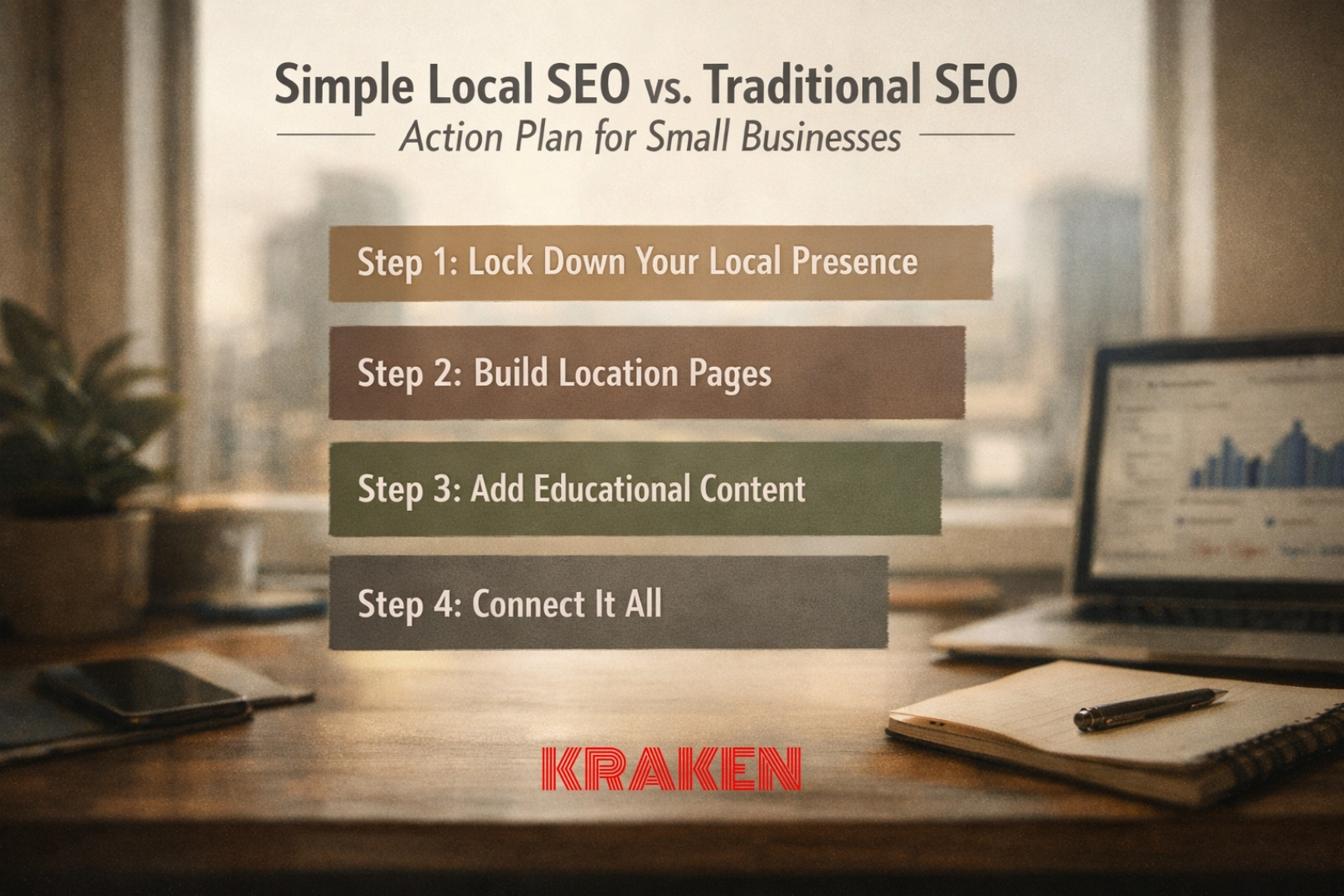
Step 1: Lock Down Your Local Presence
- Claim and optimize your Google Business Profile
- Add accurate hours, services, and photos
- Start collecting reviews consistently
Step 2: Build Location Landing Pages That Convert
- Create pages like “AC Repair Sarasota” or “Dermatologist St. Pete” — build one landing page per service
- Add real proof near the top and a clear CTA
- Track outcomes like calls, forms, bookings—not just traffic
Step 3: Add Educational Content
- Write blogs answering common questions
- Include FAQs and service-specific content — Learn more about Simple FAQ Templates That Grow Traffic, Rank in Search, and Convert Visitors
- Focus on real customer concerns
Step 4: Connect It All
- Link blogs to service pages
- Use clear calls-to-action
- Track conversions (calls, forms, bookings) — Learn more about tracking what matters
Final Thoughts on Local SEO vs. Traditional SEO
The conversation around local SEO vs. traditional SEO isn’t about choosing one over the other—it’s about understanding how each supports your growth at different stages of the customer journey.
If your goal is:
- More phone calls → lean local
- More authority → lean traditional
- Long-term growth → do both
Call to Action — Where Kraken Media Fits In
If you’re not sure where your business should focus when it comes to local SEO vs. traditional SEO—or want help building a strategy that actually drives results—we’re here to help.
👉 Reach out to Kraken Media and let’s build something that works for your business, not just in theory—but in real-world results.[/vc_column_text][vc_column_text c_id=”.vc_1700072742088″]
__________________

Written by: Shakir Miller
Kraken Media LLC
[/vc_column_text][/vc_column][/vc_row][vc_row gap=”30″ p_top=”0″ m_bottom=”0″][vc_column width=”1/6″][/vc_column][vc_column animation=”fadeInUp” animation_iteration=”1″ width=”2/3″][vc_column_text c_id=”.vc_1673058043964″]
Have Questions?
[/vc_column_text][vc_column_text c_id=”.vc_1673059285910″]
Contact us to discuss how we can create a unique solution for your organization. We work with individuals and large businesses to streamline their video, live streaming, and marketing needs. Click the link below or email us directly at developer@krakenusa.com.
[/vc_column_text][vc_empty_space height="30px"][ivan_button link="https://krakenusa.com/project/video-production/" size="large" align="to-center" animation_iteration="1" template="primary-bg" c_id=".vc_1673059325405"]Video Portfolio[/ivan_button][ivan_button link="https://krakenusa.com/contact-us/" size="large" align="to-center" animation_iteration="1" template="primary-bg" c_id=".vc_1673057986881"]Contact Us[/ivan_button][/vc_column][vc_column width="1/6"][/vc_column][/vc_row]