AI Tools for Business: A Simple Guide with Simple Use Cases

Artificial intelligence (AI) has quickly moved from futuristic concepts to practical business tools. Today, AI tools for business are helping companies automate repetitive tasks, improve marketing performance, and make smarter decisions.

For small businesses, nonprofits, medical practices, churches, HVAC companies, real estate professionals, and dental offices, AI isn’t about replacing people—it’s a digital assistant saving time and enhancing productivity.

Recent research from the Pew Research Center shows that AI adoption across the workplace continues to grow as professionals find ways to integrate AI into everyday tasks such as writing, analysis, and research. The good news is that many modern AI tools are accessible, affordable, and designed specifically for small organizations.

This guide explores:

  • AI tools businesses should consider
  • What they are best used for
  • How they can support everyday operations

Why AI Tools for Business Matter

Small businesses often face a simple challenge: limited time, limited staff

AI tools help solve this by automating routine tasks so teams can focus on more meaningful work.

Common business uses include:

  • writing marketing content
  • analyzing customer data
  • responding to customer questions
  • generating social media posts
  • optimizing websites for search engines
  • organizing internal workflows

According to marketing research from Semrush, businesses using AI-powered marketing tools often improve efficiency in content production and search optimization while maintaining strong quality standards.

For smaller organizations that need to compete with larger companies, these tools can significantly improve productivity.

AI Tools for Business

AI Tools for Business Marketing and Content Creation

Marketing is one of the most common areas where companies adopt AI tools for business.

Creating consistent content for websites, blogs, social media, and newsletters takes time. AI tools for business can help generate ideas and draft content faster.

AI Writing Assistants

AI writing platforms help businesses draft articles, marketing copy, and social media posts.

They are commonly used for:

  • blog topic brainstorming
  • website content drafts
  • newsletter writing
  • social media captions
  • email marketing campaigns

For example:

  • A dermatology clinic might use AI to generate blog ideas about skincare treatments.
  • A church outreach team could summarize sermons into weekly email newsletters.
  • A real estate office might draft property marketing descriptions.

At Kraken Media, many clients use AI as a starting point for content creation, while professional editing ensures quality and authenticity. This approach works particularly well when combined with custom websites designed for long-term digital visibility.


AI Image and Graphic Creation

Visual marketing plays a major role in engagement online.

AI image tools can help businesses create graphics quickly for:

  • social media posts
  • blog illustrations
  • marketing materials
  • promotional announcements

For example:

  • An HVAC company could create graphics explaining seasonal maintenance tips.
  • A dental office might generate educational visuals about gum disease prevention.

These tools help organizations maintain consistent visual content even without a full design team.

AI Tools for Business Customer Service

Customer expectations for fast responses have increased significantly.

AI-powered chat assistants and automation tools help businesses respond quickly to common questions.

Examples of customer service AI tools for business include:

For example:

A dental practice might receive dozens of questions weekly about:

  • insurance coverage
  • office hours
  • appointment scheduling

AI tools can answer these instantly and direct patients to the correct information, allowing staff to focus on more complex service needs.

The Federal Trade Commission also encourages businesses to maintain transparency when automated systems interact with consumers. Businesses should clearly communicate when AI is being used to assist with customer responses.

AI Tools for Business Data Analysis

Many businesses collect valuable information but rarely analyze it effectively.

AI tools can help transform raw data into actionable insights.

Common uses include:

  • identifying website traffic patterns
  • analyzing customer behavior
  • forecasting seasonal demand
  • reviewing marketing performance

For example:

  • A real estate brokerage may analyze website search trends to identify the most popular neighborhoods.
  • A medical clinic might use data insights to identify which services experience the highest demand.

According to reporting from Wired, businesses increasingly use AI to interpret complex datasets and uncover patterns that may not be immediately obvious through traditional analysis. These insights allow businesses to make smarter operational decisions.

AI Tools for Business SEO and Website Optimization

Search engines themselves rely heavily on artificial intelligence, so businesses increasingly use AI tools to improve search visibility.

AI SEO platforms help with:

  • keyword research
  • competitor analysis
  • content optimization
  • identifying search trends
  • scheduling social media posts

For example:

An HVAC company in Florida may want to rank for searches like:

  • AC repair near me
  • HVAC maintenance Florida
  • Air conditioner not cooling

AI tools help identify which search phrases people actually use and suggest content that answers those questions.

Businesses often combine these insights with Kraken Media’s digital strategy, custom website development, and SEO strategies to improve organic traffic and reduce reliance on paid ads.

AI Tools for Business Social Media Management

Maintaining social media consistency can be difficult for busy organizations.

AI tools can assist with:

  • caption writing
  • post scheduling
  • content ideas
  • engagement analysis

For example:

  • A church ministry might schedule weekly inspirational messages.
  • A dermatology office could share educational skincare tips.
  • A real estate agent might generate neighborhood highlights.

AI can suggest post ideas based on seasonal events, trending topics, or audience engagement patterns. However, businesses should always review and personalize content to maintain authenticity.

Read more about What Is Conversational AI? How Small Businesses Can Win at Digital Marketing and Preparing Your Content for Conversational AI & Voice Search.

AI Tools for Business Video and Media Production

Video content continues to dominate online engagement.

AI tools now assist with many aspects of video production, including:

  • caption generation
  • video editing assistance
  • script writing
  • creating short social clips

For example:

A dental implant specialist could record a short educational video explaining dental implants.

AI tools could automatically:

  • generate captions
  • create short clips for social media
  • suggest titles and descriptions

When combined with professional videography and editing, these tools help businesses produce engaging visual content consistently.

Read more about How to Make Short Digital Marketing Videos to Win Attention for Small Businesses and why A High Quality Videographer Can Make Your Brand.

Responsible Use of AI Tools for Business

While AI tools provide many benefits, businesses should adopt responsible practices.

Human Review

AI content should always be reviewed before publishing to ensure accuracy and brand alignment.

Protect Sensitive Data

Businesses should avoid entering private customer information into public AI systems.

Transparency

If AI systems are interacting with customers, transparency helps maintain trust.

Guidance from the National Institute of Standards and Technology AI Risk Management Framework emphasizes responsible AI practices focused on transparency, security, and accountability.

The Future of AI Tools for Business

Artificial intelligence will continue evolving rapidly, but its most powerful role for small businesses will remain supporting human creativity and decision-making.

Organizations that strategically adopt AI tools for business can:

  • reduce repetitive work
  • improve marketing consistency
  • better understand customer needs
  • compete with larger companies

The key is focusing on tools that provide real operational value, rather than simply adopting technology because it is trending.

Final Thoughts on AI Tools for Business

AI tools for business are becoming essential for organizations that want to operate efficiently and remain competitive in a digital environment. From marketing and analytics to customer service and content creation, these tools can dramatically improve productivity when used thoughtfully.

For many organizations, the biggest challenge isn’t understanding AI — it’s knowing which tools to use and how to integrate them into everyday workflows.

Call to Action — Where Kraken Media Fits In

If you are curious about how AI tools for business can support your marketing, website strategy, or digital content production, the team at Kraken Media is always happy to help.

Whether you operate a church, healthcare practice, HVAC company, nonprofit, or real estate agency, we can help you explore practical ways to integrate AI into your digital strategy.

Have questions about AI tools for business?
👉 Reach out to Kraken Media to start the conversation and let’s build an AI strategy that works for your business.

__________________

Written by:  Shakir Miller
Kraken Media LLC

Have Questions?

Contact us to discuss how we can create a unique solution for your organization.  We work with individuals and large businesses to streamline their video, live streaming, and marketing needs.  Click the link below or email us directly at developer@krakenusa.com.
Local Business Directories for SEO in 2026: The Profiles That Matter Most for Visibility

If you run a small business in 2026, your website is only part of the picture. Your visibility also depends on the local business directories and profiles that confirm:

  • who you are
  • where you operate
  • why people should trust you

For many companies, those listings often shape the first impression before a customer ever reaches the website. That matters even more now because local discovery is expanding across search, maps, voice, and AI-assisted experiences.

So when we talk about local business directories for SEO, we are not just talking about citation cleanup. We are talking about the profiles that help customers find you, help platforms trust your business details, and help your broader marketing work harder.

Strong local visibility usually comes from a combination of accurate directory profiles, a well-built website, local SEO strategy, and real photo or video content that supports trust.

Why local business directories still matter in 2026

A lot of small business owners hear “directories” and think outdated SEO tactics from years ago. That is not what this is.

Today, local business directories matter because they help reinforce the basics of local trust:

  • your business name
  • your address or service area
  • your phone number
  • your website
  • your category
  • your hours
  • your services
  • your reputation

Google’s guidance says businesses with complete and accurate information are more likely to show up in local search results. In other words, local business directories and profile quality still matters. Local citations play a big role, too—check out more here: Local Citations for SEO: What to Do and Why It Works

Semrush notes that updated local business directories can improve visibility in search engines, AI tools, and voice assistants. That is an important shift. A local directory listing is no longer just a citation. It is part of the data layer that supports discovery across multiple platforms. 

For example:

  • A church may show up when someone searches for services near them this weekend
  • A dental office may get compared based on reviews, office hours, and photos
  • A dermatology practice may get judged by professionalism before a patient clicks through
  • An HVAC company may lose a lead over a wrong phone number or missing emergency hours
  • A real estate team may appear less established if office details vary by platform

That is why the right local business directories matter.

local business directories

Your priority local business directories for SEO

For most service-based and community-based organizations, these are the profiles that should be treated as top priority:

These are the profiles that tend to have the biggest practical impact on visibility, credibility, and consistency.

Google Business Profile is still the first one to get right

If you only have time to perfect one listing, start here.

Google says complete and accurate Google Business Profiles are more likely to appear in local results, and it specifically points businesses toward keeping hours, photos, service details, and other profile information up to date to improve your local ranking.

For many businesses, Google Business Profile is now the real front door to local business directories. Someone may never even reach your homepage before deciding whether you seem trustworthy.

That means the basics need to be right:

  • primary category
  • service categories
  • phone number
  • business description
  • hours, including holiday hours
  • website link
  • services or treatments
  • real images and recent updates

Learn more about Google Analytics for Beginners in our dedicated blog.

For a dental office, that might include implant services, sedation info, and updated office photos. For an HVAC company, it might mean emergency service hours and clearly listed service areas. For a church, it may be service times, childcare details, and directions.

This is also where reputation management matters. The FTC’s rule on consumer reviews addresses deceptive review practices, including fake and misleading reviews, with courts able to impose civil penalties for knowing violations.

That makes the old shortcut mentality even riskier. Learn more about powerful online reviews and how they can make (or break) your small business.

Apple Business Connect deserves far more attention than it gets

A lot of small businesses still ignore Apple Maps visibility, which is a mistake.

Apple announced in October 2024 that businesses of all sizes, including those without a physical storefront, can manage how they appear to more than 1 billion Apple users through Apple Business Connect. Apple says verified businesses can create a consistent brand and location presence across Apple Maps, Wallet, Mail, and other apps.

That is especially important for businesses like:

  • HVAC and home-service providers
  • mobile or service-area medical businesses
  • real estate teams
  • nonprofit outreach organizations
  • appointment-driven service businesses

If your customers use iPhones, Siri, or Apple Maps, this is not optional background work anymore. It is part of your visibility stack.

One of the biggest wins here is accurate categorization and brand consistency. A business that clearly tells Apple what it is and where it operates has a better chance of being understood and surfaced properly in the places Apple users actually search.

Yelp still matters for comparison-stage trust

Yelp is not equally important for every business, but it is still highly relevant in many service categories.

Yelp’s business tools continue to position the platform as a place where businesses can be discovered by category, service, and location, and its newer 2025 product updates show the company continuing to invest in AI-assisted search and smarter discovery features. 

For many local businesses, Yelp plays a strong supporting role in trust.

Someone may find your business on Google, then check Yelp to confirm:

  • review quality
  • photo quality
  • responsiveness
  • professionalism
  • service clarity

A few simple Yelp priorities:

  • claim the page
  • upload real photos
  • keep categories accurate
  • make services clear
  • monitor profile completeness

Yelp also provides tools for adding photos and managing the business page, which makes it easier to keep the profile from feeling stale.

Facebook and Instagram still support visibility and legitimacy

Some businesses do not think of Meta profiles as local business directories, but customers often do.

A Facebook business page and Instagram professional profile help confirm that a business is active, current, and real. Meta’s business help resources and Meta Business Suite continue to support content management, messaging, scheduling, and insight tracking across Facebook and Instagram.

That matters for local SEO in indirect but meaningful ways.

A strong Facebook or Instagram presence can support:

  • branded searches
  • trust signals
  • event promotion
  • social proof
  • content reuse
  • cross-platform consistency

For example:

  • A church can share events, sermons, and community updates
  • A dermatology office can publish skincare education and office culture content
  • A dental office can share team introductions and treatment education
  • An HVAC brand can post seasonal reminders and service tips
  • A real estate team can publish neighborhood and listing content

This is one reason visual media matters so much. Kraken Media’s website and learning content consistently emphasize combining design, development, content, and videography into one marketing system rather than relying on a disconnected web presence.

👉 Is Your Website Dressed for Digital Marketing Success?

Industry-specific directories are where relevance gets more precise

This is where many businesses either gain an edge or stay invisible.

General platforms help establish broad visibility. Industry-specific local business directories help confirm relevance.

Examples include:

  • healthcare and provider directories for medical and dermatology practices
  • dental directories and specialty listings
  • home service platforms and trade-related directories for HVAC
  • brokerage, association, and niche real estate platforms
  • nonprofit and faith-based community directories for churches and ministries

The point is not to chase every possible directory. The point is to maintain the ones that real customers and platforms are most likely to trust.

This is also where consistency becomes powerful. When your key information aligns across Google, Apple, Yelp, Meta, and niche directories, it reinforces your business identity. When the details are messy, trust erodes quickly.

What small businesses should actually do now

This does not need to become a giant project all at once.

A practical approach looks like this:

  • Audit your top five listings first
  • Fix your business name, phone, website, hours, and category issues
  • Make sure your service area or address is represented correctly
  • Add real branded photography
  • Update service descriptions so they match what you actually offer
  • Remove old links or outdated appointment pages
  • Build a real review process that follows platform rules
  • Check that your website supports the same story your profiles tell

If your site is outdated, your work on local business directories can only do so much. Google may help people find you, but your website still needs to convert them.

A smarter way to think about directories in 2026

The best way to think about local business directories for SEO is this:

👉 They are not just listings. They are discovery signals, trust signals, and conversion support.

  • They help search engines verify who you are.
  • They help customers compare you quickly.
  • They help AI-driven systems understand your business context.
  • And they often decide whether someone calls you, books you, or skips you.

That is why the right profile stack matters more than a giant directory blast.

For most small businesses, the priority set is clear:

  1. Google Business Profile
  2. Apple Business Connect
  3. Yelp
  4. Facebook and Instagram
  5. the most relevant industry directories
  6. a few trusted local and credibility-based listings where appropriate

If those are clean, current, and supported by a strong website and real content, your local visibility is in a much better place.

Call to Action — Where Kraken Media Fits In

👉  If you want help improving your local business directories, cleaning up profiles, building stronger local SEO pages, or creating video and photo content that supports trust across your listings, reach out to Kraken Media.

We help businesses across Sarasota, Tampa, and surrounding Central Florida build digital visibility that actually supports growth.

__________________

Written by:  Shakir Miller
Kraken Media LLC

Have Questions?

Contact us to discuss how we can create a unique solution for your organization.  We work with individuals and large businesses to streamline their video, live streaming, and marketing needs.  Click the link below or email us directly at developer@krakenusa.com.
Local SEO Strategy in 2026: The Local Authority Engine That Keeps You on Top (Part 3 of 3)

If part 1 and part 2 were about getting found and building a content system, Part 3 is about staying on top when competitors catch up.

Because that’s what’s happening in most Florida markets right now: the basics are becoming “table stakes.” More businesses have a Google Business Profile. More businesses are publishing service landing pages. More businesses are “doing local SEO.”

So what separates the top 3 from everyone else?

A strong local SEO strategy that builds authority signals—the kind of proof Google, Apple, Yelp, and real customers can’t ignore.

Here’s the simplest way to think about it:

  • Foundation = accurate profiles + clear service pages
  • Content clusters = relevance at scale
  • Authority engine = trust that sticks

This Part 3 is the local SEO strategy authority engine.

If you haven’t read parts 1 and 2, STOP—check these out first:

local SEO strategy

1) Local links that actually move rankings

In a local SEO strategy, the highest-value links aren’t random backlinks from random blogs. They’re local, relevant, relationship-based mentions that prove you’re part of the community.

The link sources that matter most for a local SEO strategy

Think in categories your business can realistically earn:

  • Partners & vendors
    • For example, a dental office listed on a dental lab’s “Trusted Partners” page
    • An HVAC company listed on a builder’s preferred contractor page
  • Community sponsorships
    • Youth sports sponsor page, church event sponsor list, nonprofit fundraiser page
  • Local organizations
    • Chamber of Commerce directories, trade associations, local business alliances
  • Local PR
    • Community initiatives, charity drives, scholarship programs, public safety partnerships

A simple outreach script (that doesn’t feel spammy)

“Hey! We supported / sponsored / partnered on ____. Would you be able to add our business name and a link on the sponsor/partner page so attendees can find us?”

Pro tip: The best “local link” is one you’d still want even if Google didn’t exist—because it sends real people.

Learn more about earning local backlinks as part of your local SEO strategy in our recent blog: Earn Local Backlinks the Right Way in 2026: Partners, Sponsorships, Nonprofits

2) Listings strategy: accuracy beats volume

Most businesses think “citations” means “get listed on 200 directories.”

That’s outdated.

A smarter local SEO strategy in 2026 is:

  • fewer junk listings
  • more complete, consistent profiles on the platforms people actually use

Don’t sleep on Apple

Apple expanded Apple Business Connect so businesses can manage how they appear to Apple users across Apple apps, including businesses without a physical storefront. That’s a meaningful visibility channel if your customers use iPhone—which is a lot of Central Florida.

Your “priority listings” checklist

Focus on the listings that impact discovery and trust in your local SEO strategy:

  • Google Business Profile
  • Apple Business Connect
  • Yelp for Business
  • Facebook/Instagram business profiles (where relevant)
  • Industry listings (medical, dental, HVAC, real estate, nonprofit directories)

Local SEO strategy rule

If your name, address, or phone (NAP) differs across platforms, you’re paying a “trust tax.”

3) Reviews: velocity + responses, and the compliance shift you can’t ignore

Reviews have always mattered for conversions. But now they also matter for risk.

The FTC’s Consumer Reviews and Testimonials Rule went into effect October 21, 2024, targeting deceptive review practices and enabling civil penalties for knowing violations. That’s not theory—it’s real compliance. See the FTC’s Questions & Answers on the rule.

What to avoid (simple)

  • Buying reviews
  • Incentivizing reviews without proper disclosure
  • Filtering requests so only happy customers are asked (review gating)
  • Fake testimonials or AI-generated reviews presented as real

Learn more here: Powerful Online Reviews can Make (or Break) your Small Business

What to do instead (safe and effective)

A sustainable local SEO strategy uses review velocity—steady, consistent reviews over time—plus strong responses.

Here’s a simple review system most service businesses can run:

Ask at the “win moment”

  • HVAC: when cooling is restored and the customer feels relief
  • Dental: after a smooth, pain-free appointment
  • Dermatology: after a clear plan and first visible improvement
  • Real estate: right after the media delivery and listing goes live

Make it effortless

  • QR code at checkout
  • Text follow-up with a short link
  • Email request 24 hours later

Respond weekly

  • Thank the reviewer
  • Reference something specific
  • Keep it professional (but some fun is okay, too!)

Yelp even encourages personalized, detail-specific responses and consistent engagement. Their guidance is here: Tips for responding to reviews on Yelp.

Current-event angle worth noting: Yelp is adding more AI-driven experiences in its platform, which reinforces the value of strong, accurate profile content and credible review ecosystems. If you want the broader context, The Verge covered Yelp’s AI-stitched videos feature.

4) Schema basics: the “under the hood” clarity layer

Schema doesn’t replace great content or reviews. But it helps search engines understand your business details and can support richer presentation in search experiences.

If your local SEO strategy includes technical cleanup, schema is a good “high leverage” step.

Schema priorities that make sense for service businesses

  • LocalBusiness / Organization schema
  • Consistent NAP in schema matching your listings
  • Services (where appropriate)
  • FAQ schema only when the FAQ is visible and truthful

For more on website schema, check this out: Website Schema Basics for Local SEO, AI Search & Rich Results

For implementation guidance, Google’s documentation on local business structured data is another good starting point.

5) Competitive gap analysis: stop guessing, start comparing

This is one of the fastest local SEO strategy “authority wins” because it tells you exactly what to improve.

Pick 3 competitors ranking above you and compare.

Quick gap checklist

  • Profile completeness: categories, services, hours, photos
  • Photo or blog cadence: are they posting weekly?
  • Review velocity: are they getting new reviews consistently?
  • Service pages: do they have deeper, clearer pages for core services?
  • Local proof: partnerships, sponsorships, local mentions?
  • Content clusters: do they have supporting FAQs and comparisons?

Then prioritize the gaps that affect both ranking and conversion:

  1. Photos
  2. Reviews
  3. Proof blocks on service pages
  4. Partnerships / links
  5. Internal linking + cluster expansion

6) Tracking that proves your local SEO strategy is working

Rankings are nice. But the best local SEO strategy measures actions:

  • Calls
  • Direction requests
  • Booking clicks
  • Form fills

Minimum tracking stack

  • Google Business Profile insights: calls, website clicks, directions
  • Website conversions: click-to-call taps, forms, booking clicks
  • Search Console: which queries and pages drive clicks

Check out: Forms + Booking That Increase Website Leads: Reduce Friction, Improve Conversions (Part 2 of 3)

If you want an official overview of what Search Console helps you measure, see Google’s Search Console “About” page.

Call to Action — Where Kraken Media Fits In

A strong local SEO strategy is a system: profiles + pages + proof + tracking. Kraken Media builds those systems for service businesses across Sarasota, Tampa, and Central Florida—through web development, content planning, and visual media that boosts trust.

If you want to explore how we’d approach your local SEO strategy, here are two helpful starting points:

👉  If you have questions or want a quick gap analysis on your market, contact us here: https://www.krakenusa.com/contact-us/ — we’ll point you to the highest-ROI next steps for your business.

__________________

Written by:  Shakir Miller
Kraken Media LLC

Have Questions?

Contact us to discuss how we can create a unique solution for your organization.  We work with individuals and large businesses to streamline their video, live streaming, and marketing needs.  Click the link below or email us directly at developer@krakenusa.com.
Content Clusters That Rank: The “Service + City” Blueprint for Local SEO (Part 2 of 3)

Once your foundation is set, the next stage is where most businesses either scale cleanly… or accidentally create a mess.

You’ve seen it:

  • 30 city pages that look identical
  • 100 pages that swap a city name and call it “local SEO”
  • Content that exists “for Google,” not for humans

That approach can backfire. Google has long warned against doorway-style pages created primarily for search engines, because they harm the user experience.

So what’s the better approach?

Build a system using content clusters:

  • One strong pillar page per service
  • Supporting content that answers real questions
  • Internal links that guide visitors toward action
  • Location support where appropriate, not everywhere

This is Part 2 of our 3-part series on local SEO authority. If you haven’t yet, you’ll certainly benefit from reading Part 1 first: Local SEO Foundations 2026: How Services Businesses Get Found in Their City

Step 1: Build pillar pages that actually deserve to rank

A pillar page is the “main page” for a core service. These are also known as landing pages. Learn more here: A Landing Page That Converts: Local Lead Generation Upgrade for 2026

Examples of Landing Pages based on Content Clusters:

  • HVAC: AC Repair, AC Installation, Duct Cleaning
  • Dental: Invisalign, Implants, Emergency Dentistry
  • Derm: Acne Treatment, Skin Cancer Screening, Botox
  • Real estate: Listing Photography, Video Walkthroughs, Drone
  • Churches: Live Streaming Setup, Youth Programs, Community Outreach

Pillar page checklist (simple, effective)

  • Clear headline: “AC Repair in Sarasota”
  • Tight summary: what you do, who you serve, where you serve
  • FAQs that reflect real phone calls
  • One primary CTA, repeated naturally

This is also where your website design, speed, and conversion strategy matters in content clusters — the content can’t do its job if the site is slow or confusing.

If you want to learn more about creating FAQs, read this: Simple FAQ Templates That Grow Traffic, Rank in Search, and Convert Visitors

Step 2: Add supporting pages that “feed” the pillar page

Supporting pages—based on content clusters and specific services—are the spokes that strengthen relevance and capture long-tail searches.

The best supporting page types for local service businesses

  • FAQ pages: “How long does AC repair take?”
  • Comparison pages: “Repair vs replace”
  • Process pages: “What to expect at your first visit”
  • Cost/financing pages when appropriate
  • Problem pages: “AC running nonstop in Florida”
  • Seasonal pages: “Pre-summer tune-up checklist”

These pages should link back to the pillar page and also link to each other where it makes sense.

content clusters

Step 3: Use location pages carefully — and make them real

Location pages can work when they genuinely help users. They become risky when they’re thin, repetitive, or misleading.

A clean rule:

  • If you can’t add real, useful, unique info as part of the content cluster based landing page, don’t create the page

How to make a location page legitimately useful

  • Add neighborhood-specific FAQs and service notes
  • Add real photos from projects in that area
  • Add proof that mentions the area naturally, for example testimonials
  • Add staff coverage and availability details
  • Add local landmarks as context for service coverage, not as keyword stuffing

Duplicate content isn’t just a penalty risk, it’s a performance drag

If pages are near-identical, you can confuse search engines about which page should rank. Semrush explains duplicate content as identical or highly similar content appearing at more than one URL and how it can affect page visibility. 

Step 4: Internal linking is the secret weapon

Internal links do two powerful things:

  • They teach search engines your site structure
  • They guide visitors from “interest” to “action”

A simple internal linking pattern

  • Blog post → relevant service pillar page
  • Service pillar page → related FAQs and related services
  • FAQ pages → pillar page + contact page

This prevents “islands of content clusters” where posts exist but don’t drive leads.

Step 5: Create content briefs so you can scale consistently

If you want to scale content clusters without chaos, write a short brief before you write.

Content brief template (fast but effective)

  • Primary query: service + city
  • Secondary queries: common variations
  • Internal links: 3–6
  • CTA placement: top, middle, bottom

When you do this for each service, your website turns into a lead machine — not a random blog archive.

Read more on our recent blog: Predictable Lead Generation: Landing Page + Website Conversion Hacks (Part 3 of 3)

Step 6: A 2026 reality check — your content must convert

Pew shared there’s less likelihood someone searching will click a website when AI summaries appear. That puts more pressure on the traffic you do get to convert.

So when you publish content, ask:

  • Does it answer the question fast?
  • Does it prove we’re the right choice?
  • Does it make the next step easy?

Call to Action — Where Kraken Media Fits In

Part 2 is all about building content that scales without becoming thin, repetitive, or confusing.

👉  If you want Kraken Media to build your pillar pages, write your briefs, and structure internal linking so every piece of content supports leads, reach out — we’ll build the blueprint around your services and your coverage area.

__________________

Written by:  Shakir Miller
Kraken Media LLC

Have Questions?

Contact us to discuss how we can create a unique solution for your organization.  We work with individuals and large businesses to streamline their video, live streaming, and marketing needs.  Click the link below or email us directly at developer@krakenusa.com.

Local SEO Foundations in 2026: How Service Businesses Get Found in Their City (Part 1 of 3)

Local SEO used to feel like a checklist. In 2026, it feels more like a race for trust.

Two things are happening at the same time:

  1. More businesses are investing in local visibility, which raises the competition bar
  2. Search behavior is shifting, and fewer people click around before they call

Pew Research found that when Google shows an AI summary, users clicked a traditional search result in 8% of visits versus 15% when no AI summary appeared. Translation: you may get fewer chances to earn the click, so when you do earn it, you need to convert it fast. (See: Pew Research Center’s analysis)

This is Part 1 of a 3-part series on Local SEO—Part 1 is the foundation of Local SEO Authority.

If you run HVAC, dental, dermatology, real estate, a medical practice, or even a church with community programs, these are the basics that determine whether you show up when someone searches service + city.

The “Service + City” reality

Local search intent is usually crystal clear:

  • “AC repair Sarasota”
  • “Emergency plumber Tampa”
  • “Dermatologist St. Petersburg”
  • “Teeth whitening near me”
  • “Real estate photographer Brandon”
  • “Church near me with youth program”

People aren’t browsing. They’re trying to solve something. Your job is to look like the best match immediately, meaning, maximize your local SEO authority to improve your site’s ranking and your chance of getting potential clients.

local SEO

Google Business Profile essentials (what matters most)

Google’s own local seo ranking guidance is consistent: businesses with complete and accurate info are more likely to show up in local results—local SEO in action.

Here’s what “complete” actually means in the real world:

Google Business Profile basics that move the needle

  • Primary category chosen correctly: this is one of the strongest relevance signals you control
  • Services filled out with real detail: don’t stop at generic labels, list your actual service set
  • Hours accurate, including holiday exceptions
  • Phone correct and consistent everywhere
  • Photos that prove legitimacy: team, trucks, office, signage, treatment rooms, equipment, completed projects

Read more here: Google Business Profile: The Ultimate Do’s and Don’ts Guide for Local Growth

Two quick wins most businesses skip

  • Add service-based photos weekly or monthly
  • Add a short keyword-friendly business description that mirrors how people search, for example “AC repair and installation in Sarasota and surrounding areas”

If you want to see how we build GBP + website together as one lead system, reach out—this aligns with how we approach Local SEO at Kraken Media.

NAP consistency: your business identity across the internet

NAP = Name, Address, Phone.

It sounds basic, but inconsistencies are common:

  • “Suite 200” in one place, “Ste 200” in another
  • Old phone number on a directory
  • Different business names, for example “Kraken Media” vs “Kraken Media LLC”

Why it matters: the web is a messy data ecosystem. The cleaner your identity, the easier it is for platforms and customers to trust what’s true, and the easier it is to capture local search with local SEO.

A simple NAP cleanup routine

  • Pick a single canonical format
  • Update your site first, then your GBP, then major profiles like Apple Maps and Yelp, then secondary listings

Core service pages: what to build first on your website

If local SEO were a house:

  • GBP is the front door
  • Service pages, also known as landing pages, are the rooms where decisions get made

Most local sites have:

  • A homepage
  • A “services” page that lists everything
  • Maybe a few blogs

What they need is:

  • One strong landing page page for each core service you want to sell

What every high-performing service (landing) page needs

  • A clear “what we do” headline
  • A tight “who we serve and where” line
  • Proof: photos, credentials, awards, reviews, case examples
  • FAQs (the questions your staff answers every day)
  • A single primary call-to-action, for example Call, Book, Request Estimate

The local ranking factors you can actually influence

Google describes local ranking as a blend of factors including relevance and prominence. The practical takeaway is simple:

  • Be the best match for the search
  • Be the most trusted option that looks real and established

That’s why the foundation is always:

  • accurate GBP
  • strong service pages
  • consistent identity
  • visible proof

Read more here: Local Search Ranking Factors: Your Ultimate Guide to Local Search Success in 2026

The “What to Build First” checklist (Basics)

If you’re busy, do this in order in just 3 weeks:

Week 1: Get your listing right

  • GBP category + services + hours + photos updated
  • Verify you’re using the correct business name and phone everywhere

Week 2: Fix the website conversion path

  • Add or rebuild your top 3–5 service pages
  • Make CTA frictionless, click-to-call, fast forms, clear booking option

Week 3: Add proof blocks

  • Reviews on key pages
  • Before/after or job photos
  • Credentials, associations, warranties, financing options if relevant

Call to Action — Where Kraken Media Fits In

Local SEO doesn’t start with content volume. It starts with clarity and trust.

👉  If you want Kraken Media to help you build the Local SEO foundation the right way — GBP, service pages, tracking, and conversion-focused design — reach out to Kraken Media and we’ll map your “build first” plan around your services and your market.

__________________

Written by:  Shakir Miller
Kraken Media LLC

Have Questions?

Contact us to discuss how we can create a unique solution for your organization.  We work with individuals and large businesses to streamline their video, live streaming, and marketing needs.  Click the link below or email us directly at developer@krakenusa.com.

SEO vs GEO vs AEO in 2026: What AI Search Means for Small Businesses

SEO vs GEO vs AEO

If you run a small business, you’ve probably noticed that search does not feel the same anymore.

People still use Google the traditional way, but they are also asking longer questions, reading AI-generated summaries, comparing options inside chat-based tools, and discovering businesses through maps, reviews, and platform recommendations. For small businesses in Sarasota, Tampa, and across Central Florida, that means visibility is no longer just about ranking one page for one keyword. It is about showing up clearly across search, AI answers, local listings, and trust signals at the same time using optimization—SEO vs GEO vs AEO. Google said in 2025 that AI Overviews had already reached more than 1.5 billion users monthly, which tells you this is not a side trend anymore. It is part of how modern discovery works.

That is where the conversation around SEO vs GEO vs AEO comes in.

A lot of business owners hear those terms and assume they are three separate marketing systems. In reality, they are better understood as three layers of digital visibility that now overlap. If you are a dental office, dermatology practice, HVAC company, nonprofit, church, or real estate brand, the goal is not to choose one and ignore the others. The goal is to understand how they work together so your business is easier to find, easier to trust, and easier to choose.

What each term actually means — SEO vs GEO vs AEO

SEO is still the foundation

SEO, or Search Engine Optimization, is still the base layer. This is the work that helps your website rank in traditional search results for the services you actually provide.

That includes things like:

  • strong service pages
  • clear page titles and headings
  • local relevance
  • internal linking
  • fast page speed
  • structured data
  • original photos and media
  • useful written content

Google’s own guidance still emphasizes creating helpful, reliable, people-first content and making pages easy for search systems to understand. Structured data also still helps Google understand the content on a page and can support richer search appearances.

For example, if an HVAC company has dedicated pages for AC repair, maintenance plans, ductless systems, and heat pump water heaters, that company has a much stronger SEO base than a competitor with one vague “services” page. The same is true for a periodontist with detailed pages on implants, gum grafting, sedation, and recovery FAQs.

At Kraken Media, that foundation is a big part of how we approach custom website strategy and SEO-focused growth.

Learn more about Website Schema Basics for local SEO, AI Search, & Rich Results from a recent blog.

AEO is about becoming the answer

AEO, or Answer Engine Optimization, is about making your content easy to surface when users ask direct questions and platforms try to answer them quickly.

Think of searches like:

  • “How long does a dental implant take?”
  • “Why is my AC running all day in Florida?”
  • “What skincare ingredients help oily skin?”
  • “What should a church look for in a livestream setup?”

This is where content structure matters as much as keyword targeting. The strongest AEO content usually does three things well:

  • it answers the question early
  • it explains the answer clearly
  • it organizes the page so a person and a machine can both follow it

Google’s 2025 guidance on succeeding in AI search still points creators back to the same core principles — provide unique value, strong page experience, and content built for people first, not for manipulation.

In plain English, AEO means your content should sound like a helpful expert, not a page trying too hard to “rank.”

Learn more about Answer Engine Optimization (AEO): The Future of Search for Small Businesses in our recent blog.

GEO is about AI-driven discovery

GEO, or Generative Engine Optimization, is the broader layer that deals with how your brand appears inside AI-assisted discovery, summaries, comparisons, and recommendation flows.

This matters because AI systems often pull from more than just one page on your site. They may synthesize signals from:

  • your website
  • your service pages
  • your reviews
  • directory listings
  • map profiles
  • business attributes
  • branded content
  • public mentions and citations

So if someone asks an AI tool something like:

  • “Who are trusted HVAC companies near Tampa?”
  • “Which dermatology offices are known for acne treatment?”
  • “What real estate media company offers drone and video in Central Florida?”

…the system may be influenced by the strength and consistency of your entire digital footprint, not just your homepage copy.

That is why GEO is becoming more important for small businesses. It rewards brands that are easy to verify, easy to summarize, and easy to trust.

Why this matters more in 2026

The real shift is not that search engines disappeared. It is that users are now getting more of the answer before the click.

A 2025 Pew Research Center analysis found that Google users were less likely to click on traditional links when an AI summary appeared. When users saw an AI summary, they clicked a traditional result in 8 percent of visits, compared with 15 percent when no AI summary appeared. They also rarely clicked links inside the AI summary itself.

That matters for business owners because it changes the win condition.

The old mindset was:

  • rank
  • get the click
  • convert the lead

The newer mindset is:

  • rank where you can
  • become part of the answer
  • build trust before the click
  • stay visible across listings, maps, and AI-driven discovery
  • make the eventual click count more

So no, SEO is not dead. But it is no longer the whole story.

What AI search rewards — SEO vs GEO vs AEO

Across SEO vs GEO vs AEO, AI search tends to reward the same broader qualities:

  • clarity — easy-to-understand pages and direct answers
  • specificity — detailed service pages, not generic filler
  • consistency — matching business information across platforms
  • credibility — real reviews, bios, expertise, and trust signals
  • structure — headings, FAQs, schema, and organized page flow
  • originality — real photos, videos, examples, and experience

Google’s documentation still stresses helpful content and crawlable site structure, while structured data helps search systems classify and interpret what a page is about.

For small business owners, that means the basics matter more than ever:

  • your services should be clearly defined
  • your location signals should be obvious
  • your FAQs should answer real customer concerns
  • your images and videos should be original
  • your internal links should guide users logically
  • your business information should match across the web

SEO vs GEO vs AEOLocal visibility now feeds AI visibility

One of the most overlooked parts of this conversation is that local platform data is increasingly part of brand discoverability.

Learn more about Conversational AI & How Small Business can Win at Marketing and how to Prepare your Content for Conversational AI & Voice Search in other recent blog posts.

Apple says businesses can use Apple Business Connect to manage how they appear across Apple Maps, Wallet, Mail, and more, and Apple expanded those tools in 2024 so even businesses without a physical storefront can manage their presence. Yelp’s support guidance also emphasizes accurate business information at the individual location level, which matters for trust and consistency.

That means your local presence is no longer just “nice to have.” It feeds the larger picture of whether platforms can confidently understand who you are, what you do, and where you serve.

For example:

  • a church should have accurate service info, hours, and visual identity
  • a medical or dental office should have consistent specialties, bios, and location details
  • an HVAC company should clearly show service area, emergency options, and financing details
  • a real estate media brand should show specialties like drone, photography, video, and floor plans

This is also why local citations for SEO work and question-based content strategy matter more now than they did a few years ago. They are no longer just “SEO tasks.” They help make your business legible to modern discovery systems.

Trust is now part of optimization

If AI systems are summarizing brands, trust signals matter even more.

That includes reviews, authority, consistency, and transparency. It also means fake shortcuts are a worse bet than ever. The FTC’s rule on the use of consumer reviews and testimonials went into effect on October 21, 2024, and addresses deceptive conduct involving fake or false reviews and testimonials.

Learn more about how to create powerful online reviews and how they can make or break your business.

For small businesses, the practical takeaway is simple:

  • ask for real reviews
  • never buy reviews
  • respond professionally
  • keep business details current
  • show real expertise
  • use real photos and real examples

If your business looks polished but feels unverifiable, that is a problem. If your business looks consistent everywhere and your content reflects genuine expertise, that becomes an advantage.

What this looks like in real industries — SEO vs GEO vs AEO

For dental and medical practices

SEO helps service pages rank for treatments and specialties. AEO helps answer patient questions about procedures, recovery times, and treatment options. GEO helps a practice appear more credibly when AI tools compare providers, specialties, and patient needs.

Learn more: Why Locally Focused SEO is the Best for Dental Practices: A Comprehensive Guide.

For dermatology

SEO supports treatment pages, condition pages, and local relevance. AEO helps answer searches around acne, oily skin, scarring, sun damage, and treatment expectations. GEO benefits from doctor bios, treatment detail, review quality, and a consistent brand presence across the web.

For HVAC companies

SEO captures high-intent searches like AC repair, maintenance, and system replacement. AEO helps answer practical questions homeowners ask during urgent problems. GEO improves when the company has clean service pages, location data, good reviews, original media, and useful educational content.

For nonprofits, churches, and community brands

SEO helps with visibility for services, programs, and mission-focused content. AEO helps answer what your organization does, who it serves, and how people can engage. GEO helps the organization show up more clearly when people ask AI tools about local resources, programs, or causes.

For real estate media and visual brands

SEO brings in agents, brokers, builders, and developers searching for services. AEO helps answer comparison-style questions about photography, drone, floor plans, and content marketing. GEO strengthens brand presence when the company consistently demonstrates capability through original work, niche authority, and strong digital presentation.

What small businesses should do next — SEO vs GEO vs AEO

If you want the simple version, here is the practical roadmap:

  • Keep building SEO fundamentals
    Your site still needs strong pages, clean structure, and local relevance.
  • Write for real questions
    Build content around what customers actually ask in conversation to maximize AI search results.
  • Use clear page structure
    Strong headings, bullets, FAQs, and schema help both users and platforms.
  • Strengthen your local profiles for local growth
    Google, Apple, Yelp, and industry listings all contribute to visibility.
  • Invest in original media
    Real images and video improve trust, engagement, and differentiation.
  • Audit your trust signals
    Reviews, bios, business information, and service clarity should all align.
  • Think beyond rankings
    Brand mentions, answer visibility, and assisted discovery matter too.

Final takeaway — SEO vs GEO vs AEO

Here is the cleanest way to think about it:

SEO helps you get found.
AEO helps you become the answer.
GEO helps you get recommended in AI-driven discovery.

The businesses that will do well in 2026 are not the ones chasing every new acronym. They are the ones building a digital presence that is clear, useful, trustworthy, and easy for both humans and AI systems to understand.

Call to Action — Where Kraken Media Fits In

👉 If you want help making sense of SEO vs GEO vs AEO for your business, reach out to Kraken Media. We help businesses across Sarasota, Tampa, and Central Florida build stronger websites, smarter content, and high-quality digital media that supports visibility in search, AI answers, and local discovery.

__________________

Written by:  Shakir Miller
Kraken Media LLC

Have Questions?

Contact us to discuss how we can create a unique solution for your organization.  We work with individuals and large businesses to streamline their video, live streaming, and marketing needs.  Click the link below or email us directly at developer@krakenusa.com.

Earn Local Backlinks the Right Way in 2026: Partners, Sponsorships, Nonprofits

If local SEO feels harder lately, you’re not imagining it.

Two things are happening at the same time:

  1. Search is turning into “answers first” with AI summaries and fewer clicks. Pew found that when an AI summary appears, users click traditional results less often (8% vs 15%).
  2. Google has gotten louder and sharper about spam policies and manipulation. The March 2024 update called out newer forms of abuse and made it clear they’re willing to enforce.

So what still works in 2026?

Real-world trust signals that search engines can recognize: credible local mentions and links that exist because you’re genuinely involved in your community.

That’s what this post is about—earning local backlinks the right way through partners, sponsorships, and nonprofits, especially in places like Sarasota, Tampa, and Central Florida where relationships still move faster than algorithms.

And yes, we’ll keep it practical.

What “good” local backlinks actually are

Strong local backlinks usually have three traits:

  • Local relevance: The site is connected to your region (city, county, neighborhood, local org).
  • Real relationship: The link exists because you did something meaningful (partnered, sponsored, served, supported).
  • Clean intent: It isn’t a “pay me and I’ll link to you” scheme.

Google’s spam policies are clear that buying and selling links for ranking purposes is a problem, but sponsorship/advertising local backlinks can be fine when they’re properly qualified (for example using rel=”sponsored” or rel=”nofollow”).

That’s the line we’ll walk: supporting the community, earning visibility, staying compliant.

Quick translation for small business owners:
You want local backlinks that look like they were created for humans, because they were.

The 2026 mindset shift: local backlinks are a byproduct of being known

In 2018, you could do “link building.” In 2026, the best link building is a mix of:

  • Brand building (people recognize you and mention you)
  • Local presence (you show up in the places your customers already trust)
  • Proof (photos, events, powerful online reviews, partnerships, real impact)

That’s why Kraken Media’s approach to SEO is tied to assets that make sense in the real world—local content, landing pages, and brand proof—not just “ranking tricks.” If you want a snapshot of how we structure this, see our Local SEO approach here: https://krakenusa.com/seo/

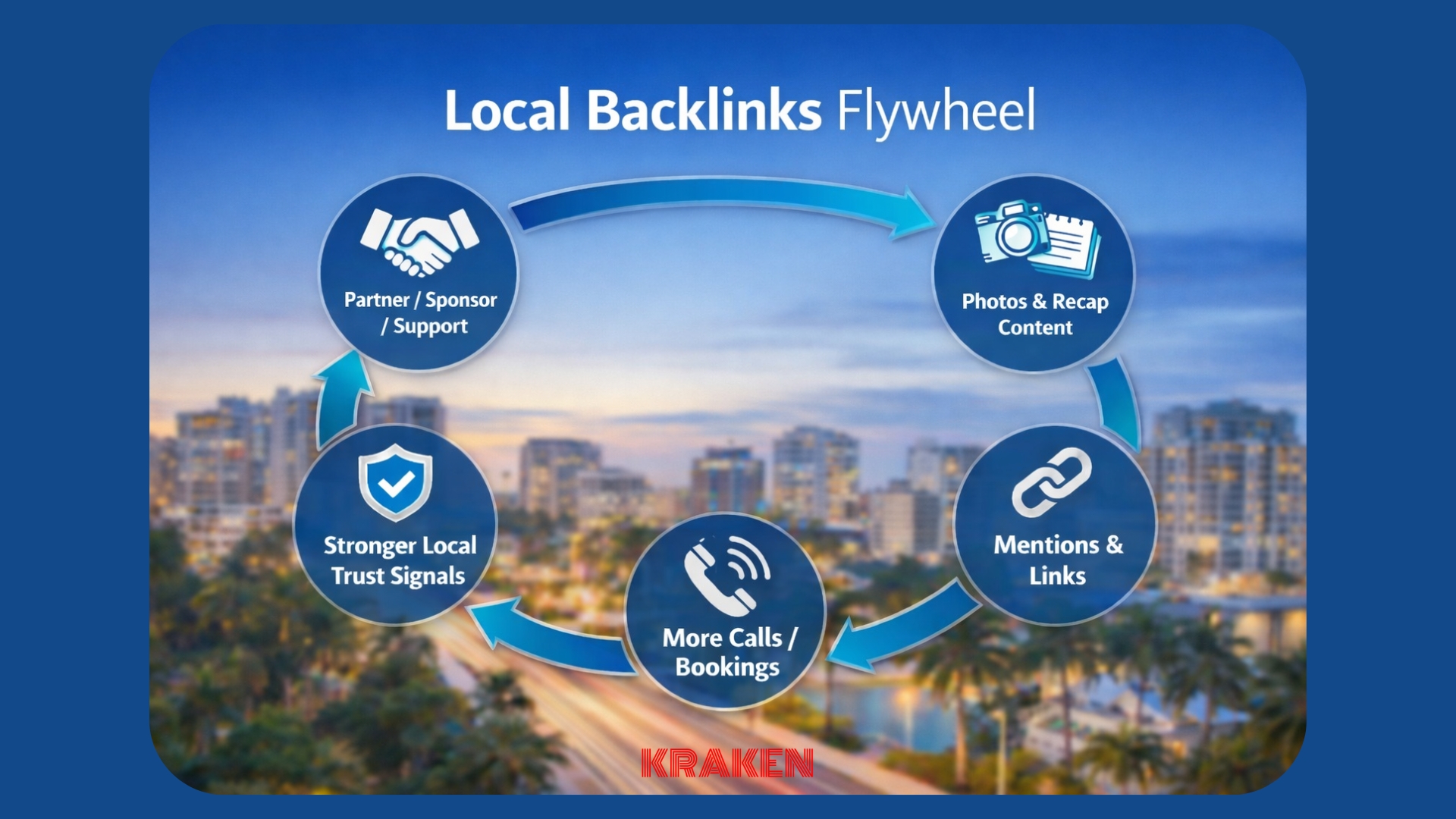
local backlinks

The “3 buckets” of ethical local backlinks

Here are the three most reliable sources that don’t feel spammy and don’t invite penalties:

1) Partners (the easiest wins you already earned)

Partners are vendors, collaborators, referral relationships, and adjacent businesses.

Examples (realistic and local):

  • A dental practice partners with an orthodontist, oral surgeon, pediatric dentist, or a local lab
  • An HVAC company partners with a builder, property manager, insulation company, or electrician
  • A dermatology office partners with med spas (non-competing services), local wellness brands, or women’s health clinics
  • A church partners with food banks, youth sports, counseling services, or community events
  • A real estate team partners with lenders, home inspectors, staging companies, movers, and restoration companies

How to earn local backlinks (without making it weird):

  • Add a “Trusted Partners” page on your site (clean, helpful, not a link farm)
  • Offer a short partner blurb + logo + service area
  • Ask for a reciprocal mention only if it benefits users (not “link swaps for SEO”)

Simple outreach script (copy/paste):

  • “Hey [Name], we’re updating our local partner resources page. Want us to include your info and link? If you keep a partner page too, we’d love to be listed so customers know who we work with.”

What to put on your partner page (fast checklist):

  • Partner name + what they do
  • Who it’s for (for example “after-hours HVAC emergency” or “pediatric-friendly dentistry”)
  • Service area (Sarasota, Tampa, etc.)
  • One clean link to their main site or contact page

Semrush calls out partnerships as a core local backlinks strategy because they’re natural and locally relevant.

2) Sponsorships (ethical, powerful, and often overlooked)

Sponsorships work because they’re a real-world signal: you supported something public.

Local sponsorship ideas that tend to generate legit backlinks:

  • Youth sports team sponsor page (often includes logos + outbound links)
  • Charity walk/run sponsor listing
  • Chamber event sponsor page
  • School fundraiser sponsor page
  • Community theater / arts sponsor page
  • Neighborhood association sponsor page

The key is how it’s published.
If an organization offers sponsor links, that’s normal. Google explicitly recognizes that sponsorship local backlinks exist, and the compliant way is to qualify them properly when needed. (Google for Developers)

What to ask for (politely):

  • A logo on the sponsor page
  • A short description (1–2 sentences)
  • A link to your homepage or a relevant community page
  • A photo of the event you can share (this helps the org too)

Pro tip: sponsor pages are common, so differentiate by helping them improve the page:

  • Offer a better logo file
  • Provide a short, clear description
  • Give them a one-line “what you sponsored” caption

Important compliance note:
If you’re promoting a paid relationship publicly, the FTC’s endorsement guidance centers on transparency—connections should be clear and not misleading.
(You don’t need legal language everywhere, just avoid implying something is an “independent recommendation” when it’s sponsored.)

3) Nonprofits (“give value first” local backlinks)

This is the cleanest category because it’s built on impact.

Ways to support nonprofits and earn real mentions:

  • Host a drive (school supplies, food, hygiene kits)
  • Donate a service (for example free AC tune-up for a shelter, free dental day, free skin cancer screening event)
  • Provide space, volunteers, or equipment
  • Offer a scholarship, internship, or mentorship
  • Co-host an event and help promote it with photos/video

Nonprofits tend to publish:

  • Partner pages
  • Event recap posts
  • Press releases
  • Sponsor thank-you posts
  • Annual report acknowledgements

These aren’t “SEO pages”—they’re the internet documenting reality.

If you want one rule that keeps you safe:
Do it even if Google didn’t exist.

The local backlinks playbook, step-by-step (small business friendly)

Step 1: Build a “link-worthy” page first

Before you ask anyone for a link, make sure you have a page worth linking to.

Good targets:

  • Homepage (if it clearly explains who/where/what)
  • A “Community” page (shows involvement)
  • A scholarship page
  • An event page
  • A local resource page (for example “Emergency HVAC checklist for Florida summers”)

Step 2: Make a target list of 25 local opportunities

Here’s a simple way to build your list fast:

Partners

  • Vendors you already pay
  • Referral partners
  • Adjacent services

Sponsorships

  • Local events you already attend
  • Youth leagues near your service area
  • Chamber/community calendars

Nonprofits

  • Causes your customers care about
  • Orgs you’ve supported before
  • Churches and community centers you’re connected to

Step 3: Offer “assets,” not just a request

Most organizations are busy. Make it easy:

  • 1 square logo
  • 1 landscape logo
  • 1 headshot/team photo
  • 2-sentence description
  • Correct website URL
  • Contact name + email

Step 4: Document it like a newsroom

This is where Kraken Media’s high quality “digital content day” mindset becomes SEO fuel.

Take:

  • 10 photos (event, people, signage, you participating)
  • 3 short clips (10–20 seconds each)
  • 1 quote (why you supported it)
  • 1 recap paragraph

That creates:

  • A post for your site
  • A post for their site
  • Social content for both of you
  • A reason for someone to link, because there’s something to reference

Where local listings fit (because backlinks aren’t the only win)

Sometimes the “link” you get aren’t traditional local backlinks—they are a profile mention that still builds discovery and trust.

Examples:

  • Apple Maps presence through Apple Business Connect (Place Cards and Actions can drive engagement). (Apple Support)
  • Yelp business profile visibility and brand credibility (especially in service categories where Yelp is active). (Yelp Support)

These are not “hacks for local backlinks”—they’re visibility infrastructure.

What to avoid (so your good work doesn’t get discounted)

Avoid “pay-to-link” directories that exist only for SEO

If the site looks like it was built for outbound links, it probably was.

Avoid excessive backlink exchanges

Occasional, natural cross-mentions are fine. Systematic swapping becomes a footprint.

Avoid low-value “guest post” farms

If they’ll publish anything for $50, it’s not a relationship, it’s a risk.

Avoid trying to sculpt sponsorship links into “SEO juice”

If you sponsored something, be proud of it. If the org marks it as sponsored/nofollow, that’s normal and often the compliant approach.

Real examples you can copy (by industry)

Dental / Medical

  • Sponsor a local health fair and provide a “what we screened/served” recap
  • Partner with a local nonprofit for free care day
  • Collaborate with adjacent providers on a “local patient resources” page

Dermatology

  • Co-host a sun safety event with a school or youth sports league
  • Provide a skin health guide for a nonprofit newsletter and ask for attribution

HVAC

  • Sponsor a youth team, then post a seasonal Florida HVAC checklist the team can reference
  • Partner with property managers and builders on a “preferred vendors” page

Real Estate

  • Support neighborhood cleanups with a photo recap
  • Partner with local contractors and publish a “trusted home services” guide

Churches / Nonprofits

  • Create a community resource hub page and invite partners to contribute
  • Run a drive, then publish the recap with partner acknowledgements

The Semrush local backlinks guide lists sponsoring events and partnering locally as repeatable strategies because they naturally generate mentions and links. (Semrush)

How Kraken Media helps (without making it salesy)

Most businesses don’t struggle because they “don’t know SEO.” They struggle because they don’t have a repeatable system for:

  • Finding local partnership opportunities
  • Creating content assets fast
  • Turning real-world activity into online proof
  • Measuring what actually turns into calls, bookings, and leads

That’s exactly where we live—web development, content, and visual media working together.

If you want a simple way to start, build your local backlinks foundation (site + pages), then run a quarterly “community + content” sprint.

Read more to learn about Local Citations for SEO: What to Do and Why It Works.

Call to Action — Where Kraken Media Fits In

👉 If you want help building ethical local backlinks and a plan that fits your business and your community, reach out to Kraken Media—we’ll help you pick the right partners, create the right pages, capture the right visuals, and turn it into a repeatable system you can run all year.

__________________

Written by:  Shakir Miller
Kraken Media LLC

Have Questions?

Contact us to discuss how we can create a unique solution for your organization.  We work with individuals and large businesses to streamline their video, live streaming, and marketing needs.  Click the link below or email us directly at developer@krakenusa.com.

Website Schema Basics for Local SEO, AI Search & Rich Results

How to Help Search Engines Understand Your Business

If you’ve been paying attention to search lately, it’s getting… weird. Not bad, just different.

Google is leaning harder into AI-powered summaries at the top of results. And according to Pew Research Center, when an AI summary shows up, people click traditional search results less often (8% vs 15%). That means you can’t just “rank” anymore and expect the same traffic you used to.

At the same time, AI features have created new trust issues. Wired recently highlighted how AI summaries can surface the wrong contact info, including scam phone numbers, if the web’s signals are messy.

So what’s the move for a small business in Sarasota, Tampa, or anywhere in Florida?

One of the most underrated “boring wins” is website schema, also called structured data.

Website schema won’t magically rank you by itself, but it does help with clarity, consistency, and eligibility for enhanced results. Think of it like giving Google and other systems a clean label on the outside of your business.

And as Kraken Media, this is where our web development + SEO + content strategy all meet to really serve our clients…

Website Schema in Plain English: What It Is, and What It Is Not

What website schema is

Website schema is a standardized way to describe what your page is about so machines don’t have to guess. Instead of hoping Google correctly interprets your page, you give it a clear, structured explanation.

Semrush puts it simply: website schema markup is structured data that helps search engines understand your organization and your pages.

What website schema is not

Schema is not a cheat code. You don’t add a block of JSON-LD and jump from page 5 to position 1 overnight.

What it does do is:

  • Reduce ambiguity (especially for local businesses with similar names)
  • Reinforce accurate business details
  • Help pages become eligible for rich results and enhanced displays
  • Improve consistency across your site when implemented correctly

Why This Matters More Now: AI Search Rewards Clarity

As search becomes more “answer-based,” the sites that win tend to be the ones that are easiest to interpret confidently.

That’s why Kraken Media has been pushing a “structure-first” mindset—clear pages, clear entities, clear internal linking, and clean technical signals. If you want the bigger picture of what matters in local visibility right now, our guide on local ranking factors breaks it down in plain language—Local Search Ranking Factors: Your Ultimate Guide to Local Search Success in 2026.

And if you’ve been thinking about voice search and conversational AI, we also covered how structured answers and schema-supported FAQs fit into that shift—Preparing Your Content for Conversational AI & Voice Search.

The Website Schema Basics to Prioritize (Small Business Checklist)

Below are the 4 schema priorities that give the most practical ROI for local and service-based businesses—especially nonprofits, churches, medical, dental, dermatology, HVAC, and real estate.

website schema1) Organization / Local Business Schema

Your “This is who we are” foundation

If your site doesn’t clearly define your organization, it’s forcing Google to infer details from scattered hints—headers, footers, contact pages, and directory listings.

Google’s Local Business structured data documentation explains that this markup can help Google understand key details like hours, departments, and other business info that may appear in search results.

Prioritize these fields first (simple, high-value):

  • Business name (exactly as you use it publicly)
  • Website URL
  • Logo
  • Phone number
  • Address (or service area, depending on the business)
  • Hours
  • SameAs links (Google Business Profile, Yelp, Facebook, etc.)

Nonprofit example (church):
If your church has multiple ministries, “departments” and accurate hours can reduce confusion and help people find the right place to show up on time.

Medical example (dermatology):
Clear business identity + correct phone number matters more than ever when AI summaries are pulling contact details. Clean website schema helps reduce “wrong number” risk.

2) Consistent NAP in Website Schema

Name, Address, Phone must match the real world

NAP consistency sounds basic, but it’s one of the easiest ways to accidentally create confusion—especially when different plugins, directory profiles, and tracking numbers get involved.

Yelp’s guidance on updating business info emphasizes keeping your core business details accurate and up to date (name, phone, address, website).

Quick NAP consistency rules that prevent problems:

  • Use one official business name everywhere (no extra keywords in the name)
  • Pick one primary phone number as the “main” number
  • If you use call tracking, implement it carefully so it doesn’t overwrite your core NAP
  • Standardize address formatting (Suite vs Ste, Street vs St) and stick with it

HVAC example:
If your trucks serve 30–60 minutes outside your office, you still want the same main NAP, while your service-area language belongs in content and properly configured profiles—not random address variations.

3) Service Schema (Where Appropriate)

Spell out what you do, for real humans and AI machines

Most service businesses have pages that are too vague:

  • “Our Services”
  • “What We Offer”
  • “Solutions”

Google and customers both prefer clarity.

Service schema helps structure what you offer so it’s not just a wall of text. Semrush’s local business schema markup guidance is a solid overview of how service-oriented schema supports understanding and technical hygiene.

Service schema basics to include:

  • Service name (specific, like “AC Repair” or “Emergency Plumbing”)
  • Service description (plain language)
  • Service area (cities/regions you truly serve)
  • Provider (your business entity)
  • Relevant page URL (the service page itself)

Dental example:
Instead of “Restorative Dentistry,” define separate services for crowns, implants, veneers, and root canals—then match each service to its page.

Real estate example:
Separate “Buyer Representation,” “Listing Agent Services,” “New Construction Guidance,” and “Relocation Services” rather than burying everything in one page.

4) FAQ Schema for High-Intent Q&A Blocks

Carefully and honestly, with real answers

FAQ sections can be powerful because they match how people actually search:

  • “How much does AC repair cost in Florida?”
  • “Does a dermatologist treat acne scars?”
  • “How long does a dental implant take?”
  • “How do I donate to a church nonprofit and get a receipt?”

Google’s FAQ Page structured data documentation explains how FAQ markup can help your content become eligible for rich results when implemented correctly.

But here’s the key: FAQ schema is not the place to get salesy.

Do this:

  • Use questions real customers ask
  • Answer clearly, directly, and accurately
  • Keep answers consistent with your actual policy, pricing ranges, and services
  • Link to deeper pages when it makes sense

Avoid this:

  • “Why are we the best dentist in Tampa?”
  • “Why should you choose us?”
    Those aren’t FAQs, they’re ads.

Honest FAQ examples that work (high intent):

  • “Do you offer emergency appointments?”
  • “What insurance do you accept?”
  • “Do you serve Sarasota and Tampa?”
  • “What should I bring to my first visit?”
  • “What does a maintenance visit include?”

Need more insight on how to create impactful FAQs? Read our recent blog: Simple FAQ Templates That Grow Traffic, Rank in Search, and Convert Visitors

The “Don’t Get Cute” Rule: Accuracy, Compliance, and Trust

Website schema is a trust signal only if it’s true.

This matters even more now that regulators are cracking down on deceptive practices. The FTC’s rule targeting fake reviews and testimonials (including enforcement tools and penalties) is a reminder that “shortcuts” are getting riskier. We talk about this more in our blog: Powerful Online Reviews Can Make (or Break) Your Small Business

So when you add schema:

  • Don’t mark up fake awards
  • Don’t claim services you don’t offer
  • Don’t add review markup you can’t legitimately support
  • Don’t publish FAQs that are really just marketing copy

You want clean signals, not clever tricks.

How to Tell If Your Website Schema Is Working

The Practical “Owner’s Dashboard” Approach

You don’t need to guess.

Google Search Console provides rich result reporting that shows whether structured data is valid and eligible for rich results.

What to track (simple and useful):

  • Errors and warnings in structured data reports
  • Pages eligible for rich results
  • Search queries that trigger enhanced appearances
  • Click-through rate changes on key service pages

Common fix list (we see these constantly):

  • Duplicate fields (like duplicate URL properties)
  • Mismatched NAP (site footer vs schema vs directory)
  • FAQ markup not matching visible content on the page
  • Using the wrong schema type for the page intent

Quick “Do This Next” Checklist

  • Add Organization/LocalBusiness schema sitewide as your foundation
  • Standardize NAP across your site, schema, GBP, and key platforms
  • Add Service schema to core service pages (not just a generic services page)
  • Add FAQ schema to a few high-intent pages where you can answer honestly
  • Validate, monitor, and refine using Search Console reports

Call to Action — Where Kraken Media Fits In

If you want website schema done the right way—accurate, compliant, and built to support local SEO and modern AI-style search—

👉 Reach out to Kraken Media—we can handle the full stack: website updates, schema implementation, service page structure, FAQ strategy, and supporting photo/video content that makes the pages convert.

__________________

Written by:  Shakir Miller
Kraken Media LLC

Have Questions?

Contact us to discuss how we can create a unique solution for your organization.  We work with individuals and large businesses to streamline their video, live streaming, and marketing needs.  Click the link below or email us directly at developer@krakenusa.com.

A Landing Page That Converts: Local Lead Generation Upgrade for 2026

If you’ve felt like “we’re getting views… but not enough calls,” you’re not imagining it.

Search is changing fast. With Google pushing more AI-driven answers and follow-up questions directly in results, more people are getting “pre-sold” before they ever hit your site. That’s good news and bad news. Good, because the click you do get is often higher intent. Bad, because your landing page has to close the deal faster than ever. Recent coverage of Google’s AI search follow-ups shows how quickly search is becoming a conversation, not a list of links—meaning fewer casual clicks and higher expectations when someone finally lands on your page (see The Verge’s update on AI search follow-ups).

That’s where landing pages stop being “marketing fluff” and start being your most important salesperson.

At Kraken Media, we build websites, landing pages, SEO, and content systems for Sarasota, Tampa, and Central Florida businesses that want leads—not just traffic. Let’s break down what quality landing pages actually do, why they matter more right now, and what to fix first if you want more conversions.

First, what exactly is a landing page (and why it’s not just “a page”)

A landing page is the page someone reaches after they click an ad, a search result, a social post, a QR code, or an email link. Google Ads defines it as the page people arrive at after clicking your ad—but the big idea applies everywhere: it’s the page that receives your intent (Google’s definition of a landing page).

Your homepage is usually a general overview.

A landing page is built for one job.

For example:

  • A dental practice homepage explains the whole office.
  • A dental implant landing page gets someone to book a consult.
  • A church homepage covers ministries and history.
  • An Easter service landing page drives RSVPs, directions, and service times.

When the page has one job, it can be designed to do that job really well.

The “current event” reality: trust is up for small business, patience is down for websites

People are more willing than you might think to choose a local, smaller brand—if you help them feel confident quickly. Pew Research has shown Americans overwhelmingly see small businesses positively, and that built-in goodwill is a competitive advantage… if your site doesn’t waste it (Pew’s 2024 snapshot on small business views).

Now pair that with how people behave today:

  • They skim fast.
  • They compare options fast.
  • They bounce fast if the page feels slow, unclear, or sketchy.

A quality landing page is how you turn that “small business trust” into an actual lead.

Quality landing pages convert because they nail the 5 decisions every visitor is making

A visitor is silently asking:

  • Am I in the right place? (Relevance)
  • Do I trust these people? (Credibility)
  • Is this easy? (Low friction)
  • Is this worth it? (Value)
  • What do I do next? (Clear next step)

When a landing page fails, it usually fails one of those five.

Here’s what “quality” looks like in plain language.

A quality landing page usually has:

  • One clear headline that matches what the person searched or clicked
  • A short subheadline that explains the outcome, not just the service
  • Proof that you’re legitimate (reviews, before/after, credentials, media, partners)
  • One primary call-to-action, repeated in smart spots
  • A fast load time, especially on mobile
  • A clean layout with scannable sections
  • Tracking that tells you what’s working

Learn more about your website homepage and how it leads to conversion: A Website Homepage That Converts for Small Businesses: The 10-Second Test (Part 1 of 3)

Speed is conversion, not “tech stuff”

Google’s Core Web Vitals guidance is basically a public statement of something every business owner already knows in their gut: slow, janky pages lose people. These metrics focus on loading speed, responsiveness, and visual stability—aka whether the page feels smooth and trustworthy in real life (Google’s Core Web Vitals overview).

If you want the simplest owner-friendly takeaway, it’s this:

  • If your landing page loads slow on mobile, you’re buying traffic you can’t keep.
  • If buttons jump around while loading, people don’t trust the site.
  • If the form is annoying, they’ll “do it later” (they won’t).

The compliance shift: “dark patterns” are getting heat—and that affects landing pages

Landing pages used to be the wild west. Now regulators are paying more attention to manipulative design patterns, especially around subscriptions, privacy, and misleading flows. The FTC has publicly called out “dark patterns” and the impact these tactics can have on consumers, which is useful guidance for ethical conversion-focused design (FTC release on dark patterns and subscriptions).

This matters even if you’re not running subscriptions, because the same design habits show up everywhere:

  • bait-and-switch offers
  • confusing fine print
  • guilt-trip popups
  • “hidden” fees or requirements
  • forms that collect way more info than needed

A high-quality landing page doesn’t trick people. It makes saying “yes” feel safe.

What “good” looks like: benchmarks and expectations

A lot of business owners think conversion rates should be massive. In reality, even a few percentage points can be a big win—especially if the leads are qualified. Unbounce has cited a median landing page conversion rate around 6.6% across industries (Q4 2024), which is a helpful baseline when you’re measuring improvement (Unbounce’s conversion benchmark).

Two practical takeaways:

  • If you’re at 1–2%, you likely have a clarity, speed, or trust problem.
  • If you’re at 5–10%+ on the right traffic, you’ve built an asset—not a page.

The Kraken Media Landing Page Checklist (built for local lead gen)

Here’s the stuff that moves the needle most for small businesses in Sarasota, Tampa, and Central Florida—without turning your page into a science project.

landing page

1) Match the message to the click

If someone clicks “AC Repair Spring Hill Emergency,” don’t land them on a generic HVAC homepage.

Your landing page should repeat and reinforce:

  • the service
  • the location
  • the next step

Semrush frames this under landing page optimization fundamentals—aligning the page to real intent so visitors feel instantly confirmed they’re in the right place (Semrush on landing page optimization).

2) Keep the page “one goal, one path”

A landing page is not a sitemap.

Use a single primary CTA like:

  • Call Now
  • Book an Appointment
  • Request a Quote
  • Schedule a Consult
  • Plan a Visit
  • Get a Free Estimate

Supporting links are fine, but don’t give people 12 different exits.

3) Add proof where it matters, not where it’s pretty

Proof should show up:

  • near the top (so confidence rises early)
  • near the CTA (so hesitation drops right before action)

That proof can be:

  • short testimonials
  • star rating screenshots (where allowed)
  • credentials and associations
  • before/after galleries (medical/dental/derm)
  • a 30–60 second “meet the team” video

And yes, review trust is becoming more regulated. The FTC’s move to curb deceptive review practices is one more reason to build trust the right way—with real proof and clean claims (Reuters coverage on the FTC’s fake review ban).

4) Make forms shorter than you think they should be

If you want more conversions, remove friction.

Try:

  • Name
  • Phone or Email
  • One “How can we help?” field

Then let your team handle the details after the lead comes in.

Read our recent blog to learn more about how to Increase Website Leads with Effortless Forms.

5) Use visuals that reduce uncertainty

Stock photos don’t answer the real fear: “Is this legit?”

Real visuals do:

  • your building
  • your team
  • your equipment
  • your process
  • your work

This is where Kraken Media’s on-site photo/video days can turn into a month of content and dramatically improve landing page trust signals.

Real-world landing page examples (from industries we serve)

Church / Non-profit: “Plan Your Visit” landing page

Goal: reduce anxiety, increase attendance, increase new visitor follow-through.

  • service times + parking info
  • what to wear, what to expect
  • kids check-in flow
  • quick directions button
  • optional RSVP (not required)

Dental: “Same-week new patient appointment” landing page

Goal: convert high-intent searches into booked visits.

  • insurance accepted (or simple financing note)
  • “what’s included” in the first visit
  • 2–3 credibility bullets about the doctor/team
  • click-to-call + online booking

Dermatology: “Acne consult” landing page

Goal: turn pain + embarrassment into action.

  • common outcomes
  • safe, factual before/after gallery
  • clear next step: consult request
  • transparent expectations (no miracle claims)

HVAC: “AC repair today” landing page

Goal: fast decisions, fast contact.

  • emergency availability
  • service area map snippet
  • badges, licenses, warranty highlights
  • call button pinned on mobile

Real estate: “Get a home value estimate” landing page

Goal: capture motivated sellers without feeling spammy.

  • quick form
  • explanation of what they receive
  • credibility: recent local wins, neighborhood expertise
  • optional: “text me the link” follow-up

Microsites vs landing pages (and when to use each)

Sometimes you don’t need one landing page, you need a small cluster designed to win a whole category.

If you’re curious about when a single landing page is enough versus when a microsite strategy makes sense, start with Kraken’s breakdown on powerful landing page design, then pair it with our approach to SEO that helps feed those pages higher-intent traffic.

(That’s the point: landing pages convert, and SEO + content systems fuel them.)

The simple upgrade path (what to do this month)

If you want better leads without rebuilding your whole site, do this in order:

  • Pick your top 1–2 money services (or highest priority offers)
  • Build one landing page per service with one clear CTA
  • Add real proof near the top and near the CTA
  • Improve mobile speed and remove layout clutter
  • Track outcomes like calls, forms, bookings—not just traffic
  • Run one small test every two weeks (headline, CTA, form length, proof placement)

That’s it. That’s the play.

Call to Action

👉 If you want a landing page that actually turns local intent into calls, bookings, and qualified leads, contact Kraken Media today! We’ll help you map the offer, build the page, capture the visuals, and set up tracking so you can see what’s working and scale it. 

__________________

Written by:  Shakir Miller
Kraken Media LLC

Have Questions?

Contact us to discuss how we can create a unique solution for your organization.  We work with individuals and large businesses to streamline their video, live streaming, and marketing needs.  Click the link below or email us directly at developer@krakenusa.com.

Predictable Lead Generation: Landing Page + Website Conversion Hacks (Part 3 of 3)

If Part 1 was “Can people instantly understand you?” and Part 2 was “Can people contact you without friction?”, then Part 3 is the real growth move:

Can you make lead generation predictable by building a repeatable conversion system—and improving it on purpose?

Because the reality right now is this: clicks are harder to earn, and attention is shorter. Pew’s analysis of Google AI summaries found users clicked traditional search results less often when an AI summary appeared (8% vs 15%). That’s a big deal for any business that depends on local search for lead generation. (Pew Research Center) And the broader trend—AI summaries compressing traffic—has a lot of industries rethinking how they convert the visitors they do get. (The Guardian)

So here’s the advanced lead generation playbook: intent-based landing pages + segmented CTAs + proof blocks + experimentation + measurement.

Let’s build it like a system.

1) Intent-based landing pages: stop sending everyone to the same “catch-all” page

Most service websites have one big problem:

They send every type of visitor to the same page… then wonder why conversion rates are inconsistent.

Intent-based landing pages or microsites match the webpage to what the person meant when they searched or clicked. This results in more instant reassurance that they are in the right spot for the right service right now.

Common intent buckets for service businesses

  • Emergency / urgent: “AC not cooling,” “tooth pain,” “same-day appointment”
  • Routine: “maintenance,” “cleaning,” “skin check,” “home valuation”
  • New customer: “first visit,” “new patient special,” “new member info”
  • Existing customer: “schedule follow-up,” “pay bill,” “service agreement”
  • High-intent service: “implant consult,” “laser treatment,” “new system install”
  • Research mode: “cost,” “process,” “reviews,” “before/after,” “FAQ”

A practical landing page guide is Semrush’s breakdown of what actually improves landing page performance and lead generation—clarity, single purpose, trust, and stronger offers. (Semrush)

The landing page rule that keeps you honest

One page, one promise, one primary action.

If the visitor came in on “Emergency AC Repair Tampa,” the page should:

  • say emergency repair
  • show your emergency availability and service area
  • make “Call Now” the primary CTA
  • prove you’re legit (reviews, license, real photos)
  • reduce uncertainty (pricing approach, response time, what happens next)

lead generation

2) Segmented CTAs: “Call now” isn’t always the best next step

The #1 advanced homepage + landing page or microsite upgrade is this:

Different people need different next steps.

Example: HVAC segmented CTAs

  • Emergency: “Call Now” (sticky button on mobile)
  • Routine maintenance: “Book a Tune-Up”
  • Replacement quote: “Get an Estimate”
  • After-hours: “Text Us” (with clear expectations)

Example: dental segmented CTAs

  • Emergency pain: “Call Now”
  • New patient: “Request Appointment”
  • Cosmetic consult: “See Options + Pricing”
  • Existing patient: “Call Front Desk” / “Patient Portal”

Google’s own guidance for ads and landing pages reinforces the importance of a clear lead generation call-to-action that tells users what to do and what to expect. (Google Help)

Quick win: Put the “emergency” CTA first only when the intent is urgent. Otherwise, you’ll funnel routine visitors into a call they don’t want to make.

3) Proof blocks on service pages: the fastest way to “de-risk” a decision

Once you start using intent-based pages, your service pages can’t just be “what we do.” They need to answer the silent question:

“Why should I trust you with this specific problem?”

A high-performing proof block includes

  • 3 short reviews that mention the specific service
  • Real photos of the team, office, trucks, treatment rooms, sanctuary, property signage
  • Badges (license, insurance, financing, associations)
  • Mini FAQ (“How soon can you come?”, “Do you take my insurance?”, “Do you offer estimates?”)
  • Process snapshot (“Step 1… Step 2… Step 3…”)

This is where your on-site content day pays off: when your page shows real evidence, visitors stop treating you like a risky unknown.

4) Booking-flow experiments: your calendar is either a lead machine or a leak

By now you’ve likely learned why it is important to build forms and booking that work (Part 2) when it comes to website lead generation. The advanced move is testing the booking flow like a system:

Experiments worth running (in order)

  1. Shorten the flow (fewer steps, fewer fields)
  2. Change the order (show availability first, then collect details)
  3. Adjust the CTA copy (“Book Now” vs “Check Availability”)
  4. Add reassurance near the button (response time, no obligation, what happens next)
  5. Offer two paths: urgent vs routine
  6. Tighten confirmation + auto-reply (reduce anxiety, increase show rates)

Google Analytics supports A/B testing concepts directly in their GA4 help documentation, defining A/B tests as randomized experiments across variants shown to users at the same time. (Google Help)

Important note: Don’t test 10 things at once. Test one meaningful change so you can trust the result.

Google Analytics—GA4—should track actions that turn into real business (lead generation), not just traffic.

If you haven’t read our Google Analytics series, check them out here:

  1. Google Analytics for Beginners: The Simple Small Business Starter Guide (Part 1)
  2. Google Analytics for Small Businesses: Track What Really Matters (Part 2)
  3. Google Analytics—Mistakes That Cost Leads and How to Fix Them (Part 3)

5) A/B testing roadmap: what to test first for service businesses

Here’s a simple roadmap that keeps testing focused on revenue outcomes, not vanity design debates.

Phase 1: The “money clicks”

Test improvements that affect the actions that results in lead generation:

  • Click-to-call rate
  • Form submit rate
  • Booking completion rate

Phase 2: The “belief builders”

  • Adding proof blocks
  • Rewriting the first 200 words for clarity
  • Swapping stock photos for real photos
  • Adding service-area clarity (“Serving Sarasota + Bradenton + Lakewood Ranch”)

Phase 3: The “offer mechanics”

  • Price framing (“starting at,” “free estimate,” “new patient offer”)
  • Financing messaging placement
  • Service guarantee language
  • Bundles (for example, “tune-up + priority scheduling”)

Phase 4: The “segment system”

  • Emergency vs routine CTAs
  • New vs existing customer paths
  • Different landing pages by service line and location

If you need help with landing page optimization best practices to improve lead generation results, reach out for a consult.

6) Heatmaps + session recordings: stop guessing, start watching

Analytics tells you what happened. Heatmaps and recordings show you why.

For example:

  • People rage-click a non-clickable element (you just found a UX trap)
  • People stop scrolling right before your pricing section (you buried the good stuff)
  • People tap the call button… and nothing happens (tracking or UI issue)

What to look for first:

  • Rage clicks (frustration)
  • Dead clicks (expected something clickable)
  • Scroll depth (where attention drops)
  • Form abandon points (which field causes exits)

7) Call tracking: the missing link for local service businesses

If you’re HVAC, dental, dermatology, real estate, or even a church that relies on calls, phone leads are often the real conversion.

But most businesses can’t answer:

  • Which page drove the call?
  • Which campaign drove the call?
  • Which keyword drove the call?
  • Did the call last long enough to count as a real lead?

Google Ads provides a documented method to track calls from your website using Google Tag Manager and a “Calls from website” conversion action. (Google Help)

Call tracking for lead generation becomes powerful when it ties back to:

  • landing pages
  • CTA variants
  • booking changes
  • real lead quality (call duration, booked appointments, closed deals)

8) Tie changes to measurable outcomes: the “predictable lead generation” scoreboard

This is the part most businesses skip—then they wonder why marketing feels random.

Your scoreboard (simple + real)

Track these before and after each improvement:

  • Lead generation volume: calls, forms, bookings
  • Lead quality: call duration, booked appointments, qualified inquiries
  • Conversion rate: by page and by traffic source
  • Cost per lead (if running ads)
  • Time to first response (how fast you follow up)

Then you can say, with confidence:

  • “This landing page increased booking completion by 18%.”
  • “This CTA change increased calls from mobile by 12%.”
  • “This proof block reduced bounce and lifted form submits.”

That’s what makes lead generation predictable: small improvements, proven by measurement, stacked over time.

How Kraken Media helps (advanced version)

This is exactly where Kraken Media thrives—building not just websites, but conversion systems that get better month after month:

  • intent-based landing pages by service + location
  • segmented CTAs (emergency vs routine, new vs existing)
  • proof blocks built from real on-site photo/video
  • tracking for calls, forms, and bookings
  • structured testing roadmap so decisions aren’t based on opinions

If you want to see how we approach high-end website builds that support real marketing goals and lead generation, start here: Website Design by Kraken Media.

Call to Action

👉 When you’re ready, contact us and ask for a “Lead Generation Conversion System Audit.” We’ll identify your biggest leaks, your highest-impact landing pages, and the first 3 tests most likely to increase leads.

__________________

Written by:  Shakir Miller
Kraken Media LLC

Have Questions?

Contact us to discuss how we can create a unique solution for your organization.  We work with individuals and large businesses to streamline their video, live streaming, and marketing needs.  Click the link below or email us directly at developer@krakenusa.com.